Why This Immersive Experience Is Getting Passed Around — And What It Gets Right

You followed a link. Maybe a friend sent it, maybe you saw it posted somewhere, maybe it showed up in a group chat with zero context and you were just curious enough to click. However you got here, the fact that you're reading this says something interesting about how VR content is starting to move through the internet.
Shared immersive experiences are having a moment. And unlike a lot of "VR is finally going mainstream" predictions that have fizzled out over the years, this one has actual momentum behind it — because it's driven by user behavior rather than hype cycles.
The Anatomy of a Shareable VR Experience
Not all VR content is created equal when it comes to shareability. Some experiences are extraordinary inside a headset but fall completely flat when someone tries to share them — either because they require specific hardware, a downloaded app, or just take too long to get to the good part.
The experiences that actually spread tend to follow a recognizable pattern. They load fast. They work on a phone browser without any setup. They deliver something visually or emotionally surprising within the first ten seconds. And they leave the viewer with a feeling they want to pass along to someone else.
That last part is underrated. The best shareable content — in any format — creates a specific emotional response that the viewer wants to recreate in someone they care about. "You have to see this" is a complete sentence, and the experiences that earn it are the ones that keep circulating.
WebXR: The Technology Making This Possible
A few years ago, sharing a VR experience meant convincing someone to buy a headset, download an app, create an account, and navigate an unfamiliar interface. Understandably, most people didn't bother.
WebXR changed that equation. It's a set of browser APIs that allow immersive experiences to run directly in a web browser, with support for everything from basic 360-degree viewing on a smartphone to full six-degrees-of-freedom interaction on a standalone headset. No app store. No download. No friction.
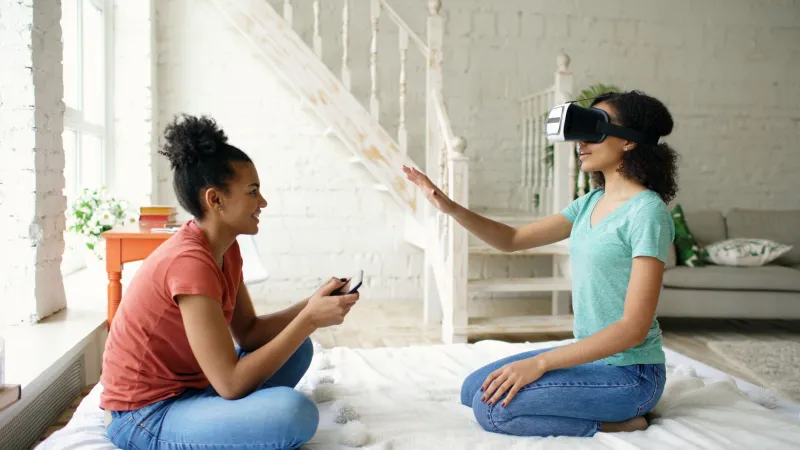
The result is that sharing a VR experience is now as simple as sharing a YouTube link. You copy the URL, you send it, and the person on the other end can be inside the experience within seconds. That's a genuinely transformative shift for how immersive content gets discovered and distributed.
For American audiences especially, where mobile browsing dominates and attention spans are short, this low-friction model is crucial. If an experience doesn't work on an iPhone or Android device within a couple of taps, most people aren't going to stick around to troubleshoot it.
What Good Immersive Storytelling Actually Looks Like
Beyond the technical accessibility, the experiences that get shared the most tend to have strong storytelling instincts baked in. This might sound obvious, but it's surprisingly rare in VR, where creators sometimes get so excited about the technology itself that they forget to give viewers a reason to care.
The best shared VR experiences use the medium's unique properties — presence, scale, spatial audio, the ability to look anywhere — in service of a specific emotional or informational goal. A virtual tour of a real place should make you feel like you're actually there, not just like you're watching a video with a wider field of view. An educational experience should use spatial context to teach you something you couldn't learn as effectively from a flat screen.
When creators get this right, the experience becomes self-marketing. Viewers share it not because they were asked to, but because they want to.
The Social Layer of VR Is Still Being Built
One of the most interesting things about the current moment in VR is that the social infrastructure around immersive content is still very much under construction. We have robust systems for sharing photos (Instagram, Snapchat), video (YouTube, TikTok), and audio (Spotify, podcast apps). But the equivalent ecosystem for immersive content is still taking shape.
Share links like this one are part of that infrastructure. Each time someone follows a shared VR link, they're participating in a distribution model that's gradually building the audience for immersive content at large. It's not glamorous, and it doesn't generate the same headlines as a new headset launch, but it's arguably more important for the long-term health of the medium.
Platforms that make it easy to generate and share these links are giving creators something genuinely valuable: a distribution channel that doesn't require the viewer to already be invested in VR. That's how you grow an audience from scratch.
Tips for Exploring Shared VR Content
If you're relatively new to immersive experiences, here's how to make the most of what you're looking at.
Don't just look forward. This sounds basic, but it's the number one mistake new viewers make. Immersive content is designed to exist in 360 degrees. Spin around. The creator put things in every direction for a reason.
Try it on multiple devices. The same experience can feel dramatically different on a phone versus a laptop versus a VR headset. If you have access to a headset and the experience supports it, that's almost always going to be the most impactful version.
Pay attention to sound. Spatial audio — where sound changes based on your orientation — is one of the most powerful tools in immersive content design. It's easy to miss if you're not listening for it, but once you notice it, it significantly deepens the sense of presence.
Come back to it. Unlike a video, which has a fixed runtime and a definitive ending, many immersive experiences reward multiple visits. You'll notice things you missed the first time.
Where This Is All Going
The share link you followed to get here is a small but meaningful data point in a larger story about how VR content is finally finding its audience. Not through hardware mandates or corporate metaverse pushes, but through the oldest distribution mechanism in the world: one person telling another person about something worth experiencing.
That's how YouTube grew. That's how podcasting grew. And if the trajectory of shared VR experiences continues, it might just be how immersive technology finally crosses from enthusiast hobby to mainstream medium.