Inside the Immersive VR Tour Experience: What Makes a Shared Link Worth Clicking
Somebody sent you a link. Maybe it was a friend, a realtor, a travel brand, or a business you'd been researching. The URL pointed somewhere unfamiliar, and you weren't sure whether clicking it would open something genuinely impressive or just another 360-degree photo slapped onto a webpage and called a "virtual tour."
We get that a lot here at GuruVR. And honestly? The gap between a forgettable tour and a legitimately immersive experience has never been wider — or more interesting to talk about.
Let's break down what actually makes a shared VR tour link worth your time, and what signals to look for before you invest even five minutes into exploring one.
Why Shared Tour Links Are Having a Moment
Over the last few years, the technology behind browser-based virtual tours has quietly gotten very good. You no longer need a headset to experience something that feels genuinely spatial. WebXR, improved 360-degree video compression, and interactive hotspot frameworks have made it possible for businesses, real estate developers, hospitality brands, and cultural institutions to deliver walkthrough-style experiences that actually land.
The result is a new category of content that gets passed around — shared in group chats, embedded in emails, dropped into social feeds. A great tour link functions almost like a recommendation. Someone found it useful or impressive enough to forward it, and now it's in front of you.
But not all of them deserve that forwarding energy.
What a Good Tour Actually Looks Like
When we evaluate a virtual tour at GuruVR — whether it's for a property, a business, a travel destination, or an event venue — we're looking at a handful of core elements.
Image quality and stitching. This is table stakes. A tour built on poorly stitched 360-degree imagery falls apart immediately. You'll see visible seams, warping around transition points, and lighting inconsistencies that break the illusion. Quality tours use high-resolution capture with careful post-processing. The moment you move through a space and the image holds up, you know someone put real effort in.
Navigation that doesn't fight you. The best tours let you move intuitively — click to walk, drag to look around, tap hotspots to get more information. The worst ones bury you in UI clutter or make it weirdly hard to figure out where you're supposed to go next. Friction kills immersion faster than almost anything else.
Contextual information layered in smartly. A tour that just shows you a space is interesting. A tour that shows you a space and tells you what you're looking at — through embedded labels, pop-up descriptions, or audio narration — is genuinely useful. The best experiences treat the virtual environment as a storytelling medium, not just a visual substitute for being there in person.
Load time and performance. In 2024, there's no excuse for a tour that takes 45 seconds to buffer every time you move to a new room. If the experience is optimized well, it should feel fluid on a standard broadband connection. Mobile performance matters too — a lot of people are going to click that shared link on their phone.
The Headset Question
Here's something worth knowing: most shared tour links are designed to work without a VR headset. That's intentional. Businesses building these experiences want the widest possible audience, which means browser-first design.
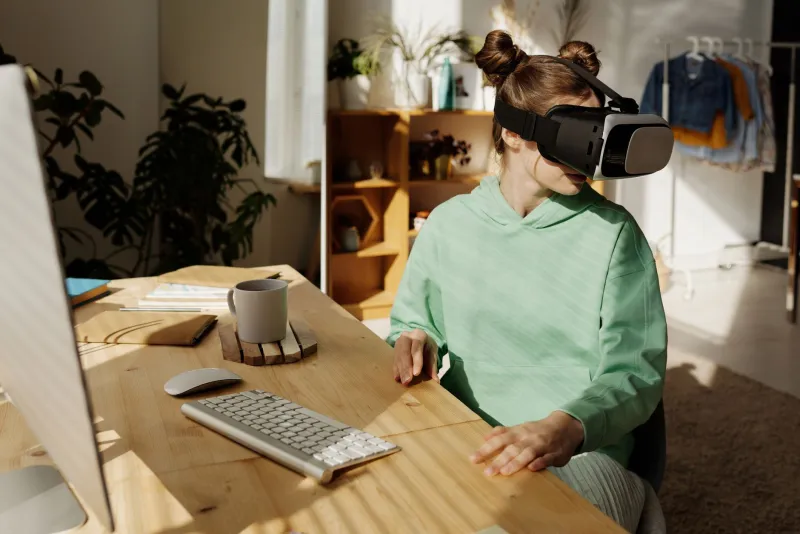
That said, if you do have a headset — a Meta Quest, a PlayStation VR2, or even a smartphone-based viewer — many of these tours become dramatically more compelling when viewed in full stereoscopic 3D. The spatial depth that a flat monitor can only suggest becomes something you actually feel when you're inside it.
If you're regularly clicking through virtual tour links for real estate, travel research, or business discovery, it might be worth bookmarking the ones that support headset viewing. The difference between a flat browser tour and the same experience in VR is significant enough that it can genuinely change how you feel about a space.
Who's Actually Building These Things?
The virtual tour industry in the US has grown into a surprisingly diverse ecosystem. You've got large platforms that aggregate tours across industries, boutique production companies that specialize in high-end real estate or hospitality, and an increasing number of in-house teams at larger brands building their own immersive content pipelines.
When a tour link gets shared widely, it's often because the production quality is high enough that people trust what they're seeing. That trust matters enormously in contexts like real estate, where someone might be making a decision about a property they can't visit in person, or in travel, where a resort is trying to convince you to book before you've ever stepped foot there.
The businesses that invest in genuinely good immersive tours are starting to see measurable returns — higher engagement, longer time-on-site, better conversion rates. That economic signal is pushing more brands to take the medium seriously.
How to Get the Most Out of Any Tour Link
A few practical tips for getting the best experience when someone drops a virtual tour link in your direction:
- Use a desktop browser if you can. The larger screen and mouse navigation usually give you more control than a touchscreen.
- Check for a headset mode. Look for a VR icon or a "View in VR" button. If it's there, try it — even a basic smartphone viewer can elevate the experience.
- Explore beyond the obvious path. Many tours have hidden hotspots or secondary rooms that casual visitors miss. Click around.
- Turn up your audio. Tours with ambient sound or narration are significantly more immersive with headphones.
- Don't rush. The instinct is to click through quickly. Resist it. Linger in spaces that interest you.
The Bottom Line
Shared VR tour links have become a legitimate content format — one that's worth understanding and worth experiencing well. The technology behind them has matured to the point where a great tour can genuinely substitute for being somewhere in person, at least in terms of getting a feel for a space.
At GuruVR, we think this category of immersive content is only going to get more important as WebXR standards improve and more businesses figure out how to use spatial media effectively. The links getting passed around today are a preview of how a lot of discovery and decision-making is going to work in the not-too-distant future.
So the next time someone sends you one? Actually click it. And maybe open it in your headset.