The Vest and the Floor: Warehouse Workers on What VR Safety Training Gets Right
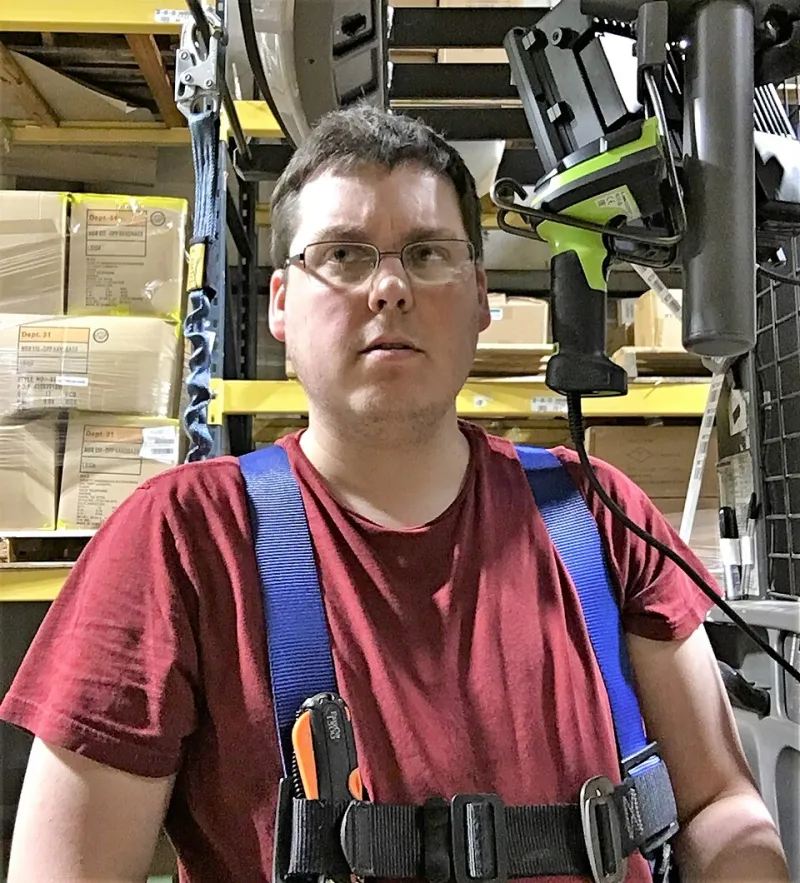
Photo: Excel23, CC BY-SA 4.0, via Wikimedia Commons
The first time a new hire at a US distribution center puts on a headset, the pitch is usually the same: practice the dangerous stuff without getting hurt. That promise is real. A virtual forklift aisle can show a pedestrian stepping out from behind racking in a way a slide deck cannot. A dock-door module can let someone make a bad decision and see the consequence without anyone losing a foot.
But workers describe a gap between the polished sales demo and the 12-minute module squeezed into a Thursday shift. The headset is sold as a safety net. On the floor, it can feel like another box on a clipboard.
What the floor sees
Logistics and manufacturing have become one of VR training's most reliable markets. The scenarios are familiar: forklift and pedestrian traffic, loading docks, pallet racking, lockout and tagout, PPE, fall protection, and emergency evacuation. Companies like the data. Completion rates are easy to track. Time-to-certify is easy to report. Incident documentation looks tidy in a spreadsheet.
Workers see a different scene. A headset is handed over with a sanitizing wipe. A trainer explains the controllers. Someone is pulled off the line during peak hours. The module starts, the timer runs, and the room fills with people waiting their turn.
What workers say actually works
When the module is good, workers tend to describe the same handful of qualities. It is short enough to hold attention. It uses the actual aisle widths and rack heights of the building, not a generic warehouse. It puts the trainee in a decision point and waits for a choice instead of playing a video with a quiz at the end. It includes pedestrians and coworkers, not just the operator. It gives immediate feedback without humiliating anyone.
Repetition without real danger is the obvious win. A new hire can practice a blind spot check ten times before ever touching a powered industrial truck. A veteran can rehearse a rare emergency, like a spill near a charging station, without waiting for the real thing. Multilingual modules and visual instruction can reach workers who struggle with dense English-only safety packets. When the training is paired with a floor mentor and a debrief, workers say the lesson sticks.
Where it becomes box-checking
The complaints are just as consistent. The virtual warehouse does not match the real one. The avatars clip through pallets. The headset fogs up. The controllers feel nothing like a pallet jack. The module is timed, and the fastest way to finish is to click through the prompts. The training is used to document compliance rather than change behavior. No one reviews the results with the worker afterward.
That last point matters. Safety training is supposed to be a conversation about judgment, not a receipt. If the only output is a completion percentage, the module is doing administrative work, not safety work. Workers notice when a training is scheduled during the busiest hour, when the headset is shared without a fresh interface, or when the same generic module is used in a freezer, a dry goods aisle, and a loading dock.
The fidelity trap
More realism can help, but it is not automatically better. A photorealistic warehouse that does not match your building can teach the wrong muscle memory. If the virtual aisle is wider than the real one, the trainee learns a clearance that does not exist. If the virtual forklift has no weight or vibration, the lesson about momentum is thinner. If the simulation is too immersive, some workers spend the first minutes fighting nausea instead of learning.
A simpler simulation with accurate decision points can beat a beautiful one with vague choices. The question is not whether the headset feels real. The question is whether the training transfers to the floor on Monday.
How to tell whether a module is preparing people
Ask whether the scenario uses your building's layout, rack heights, and traffic flow. Ask whether it branches based on the trainee's decisions or just plays a fixed sequence. Ask whether it assesses judgment or click speed. Ask whether there is a debrief with a trainer. Ask whether pedestrians, coworkers, and shift-change traffic are part of the scene. Ask whether the module supplements floor mentoring or replaces it. Ask whether workers were consulted in the design. Ask whether sessions are paid, paced, and accommodated for people with vision, balance, or language needs. Ask what data the headset collects and who sees it.
A module that cannot answer those questions is not ready to be the centerpiece of a safety program. It might still be a useful warm-up. It should not be the only training a new hire gets before walking into a live aisle.
The labor question
Training is work. If a worker is pulled off the floor to put on a headset, that time should be paid and counted honestly. If the headset collects performance data, workers should know what is recorded and how it is used. Safety training should not become another productivity metric or a way to shift blame onto the person who failed a simulation.
The best modules workers describe are the ones that give them language for hazards they already sensed. The worst are the ones that make a dangerous job look like a video game and call it preparation. VR can be a useful safety net. It is not a substitute for a floor that is actually safe, a trainer who listens, and a schedule that gives people time to learn.